
A warning from history
How the world’s mightiest empire lost itself once before

If we’re honest, most of us are spending a lot of time tracking the price of gas and very little time thinking about what kind of world is being built around us. The news comes so fast and hits so hard that it’s easier to consume the crisis than to make sense of it.
History can help with that. Not as prophecy — but as pattern recognition. “There’s nothing new under the sun,” Harry Truman liked to say, “except the history you don’t know.” The future never repeats the past exactly. But shapes recur, again and again, with eerie fidelity.
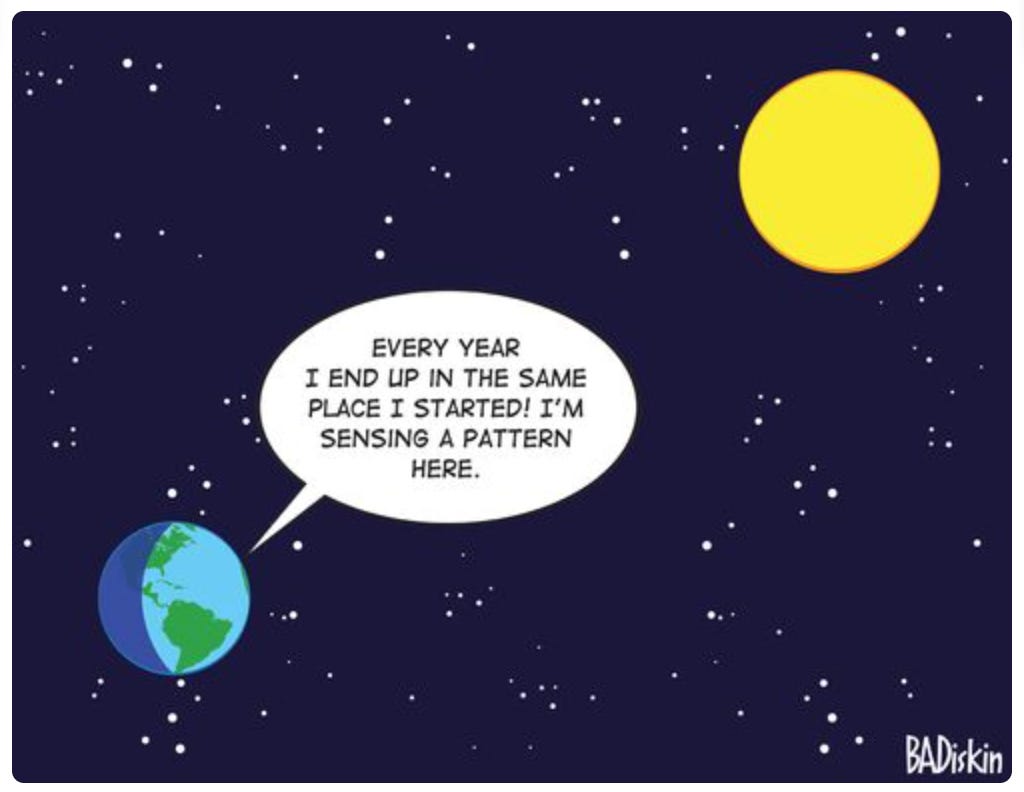
Source: Brian Diskin, www.CartoonStock.com
Here is a shape worth knowing.
The empire that couldn’t imagine falling
In the year 755, the Tang Dynasty of China was the most powerful civilization on earth. Wealthier, more sophisticated, and militarily dominant — much like the United States since 1945.
At a time when much of Europe had reverted to subsistence farming and forgotten what roads were for, Tang China encompassed the world’s largest single market. From the unmatchable riches this produced, Tang emperors projected military power deep into Central Asia and attracted traders and visitors from all over the known world.1
Tang subjects, like Americans in the 20th century, could not imagine their civilization being relegated to weakness and dependency. They were too big, too rich, too advanced, too powerful.
Then a series of bad decisions went catastrophically wrong. All at once.
How it started: the wrong men in the wrong places
The first problem was that self-serving men had been allowed to accumulate too much power at court. An Lushan — a charismatic military commander — and Yang Guozhong — a scheming court favorite — each clawed their way into positions of enormous influence. Neither had the empire’s interests at heart. It was, for both of them, entirely about personal advantage.
This is, of course, not entirely unlike a country whose political system elevated a relentlessly self-dealing operator — disdainful of foundational norms of decency, rule-following, and the common good — to its highest office. Twice.
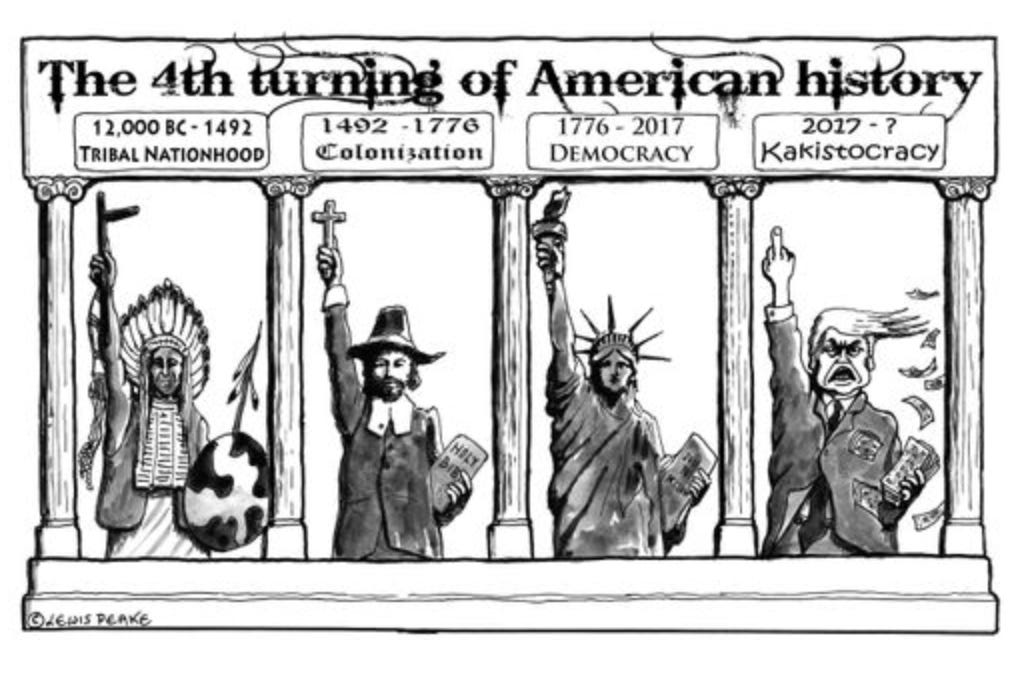
Source: Lewis Peake, www.CartoonStock.com. “Kakistocracy”: Government under the control of a nation's worst or least-qualified citizens.
The strong position, and the fatal order to abandon it
Court rivalry eventually exploded into open rebellion. An Lushan raised his armies and marched on the Tang capital.
The Tang court was secure. The imperial army held Tongguan — a mountain pass of extraordinary natural strength, guarding the only viable approach to the capital Chang’an. The rebel forces hammered at it for months and got nowhere. The position was, by every military assessment, impregnable.
The American analogy is the strategic posture the United States built after 1945: a resilient coalition of allies, bound together by trade and shared institutions, that contained revisionist rivals without requiring direct confrontation. It won the Cold War. It kept China in check for decades. It was, by every reasonable assessment, the superior position.
Back in Tang China: then came the court intrigue.
Yang Guozhong — the scheming minister — distrusted the generals holding Tongguan. He feared that powerful and independent military commanders were a threat to him personally. So he pressured the emperor to order General Geshu Han to abandon the pass and take the fight to the rebels on the open plains.
It was, from a military standpoint, insane. Everyone who understood warfare knew it. And it happened anyway — because a frightened man with political power had opinions about military strategy. This, too, has a familiar ring.
The parallel writes itself. Donald Trump distrusted the national security establishment — correctly sensing that their loyalty was to the Constitution, not to him personally. He sidelined the professionals and, mid-negotiation with Iran, ordered a unilateral military offensive — without consulting a single ally beyond Israel, without preparation, without a strategic framework.
Yang Guozhong would have recognized the move.
The outcome
Once the Tang army abandoned Tongguan and descended to the plains, it was annihilated. The road to Chang’an lay open. The capital fell. The emperor fled in humiliation.
Trump’s offensive against Iran has produced a structurally similar result. The United States has discovered, expensively and publicly, that its legacy weapons systems — costly ships, advanced aircraft, precision missiles — are newly vulnerable to ultra-cheap drone technology. This revelation is not lost on anyone watching. Every rival power is taking notes.
More gravely: by abandoning the soft-power coalition that was America’s Tongguan — the web of alliances, norms, and institutional trust that made rivals think twice — Trump has stripped away the deterrence that had kept Iran’s most dangerous option off the table. The Strait of Hormuz is now closed. That was always Iran’s trump card; what prevented them from playing it, until now, was exactly the multilateral pressure and credibility that Trump dismantled.
Strategically, the United States has lost this war.
What happens after the battle
The Tang dynasty didn’t fall immediately. It staggered on for another century and a half. But it was never the same.
The An Lushan Rebellion dragged on for years, devastating the economy and depopulating the north China heartland. Regional military governors — the jiedushi — seized effective autonomy. The central government became a shadow of its previous self, manipulated by court factions and dependent on the very warlords it could no longer control. The Tongguan disaster was the turning point: the moment when high Tang became inevitable Tang decline.
The deeper consequences were geopolitical and lasted for centuries.
As David Chaffetz describes in his 2024 magisterial history, Raiders, Rulers, and Traders: The Horse and the Rise of Empires2, the horse was to pre-modern Eurasia what petroleum was to the 20th century: the decisive strategic resource on which military power, trade dominance, and imperial reach all depended. From about 500 BCE to 1500 CE, control the horse supply, and you controlled the world. Lose it, and you began to lose everything else.
Before the rebellion, the Tang faced westward — projecting power across Central Asia, dominating the Silk Road (which Chaffetz persuasively argues should be called the Horse Road, since horses dwarfed silk in value and were themselves used as currency), and directly controlling the steppe frontier zones where warhorses were bred. The Tang cavalry was, at its peak, a formidable machine: the dynasty maintained 700,000 horses across 58 stud farms, with the remainder requisitioned from surrounding steppe peoples. Military power, at its root, has always been a logistics problem — and the Tang had solved it.
After the rebellion, Tang influence in Central Asia collapsed. Garrisons withdrew. The Uyghur Khaganate and other steppe powers filled the vacuum — and extracted a steep price for helping suppress the very uprising that had opened the door to them. This set the basic pattern for the next thousand years.
As Chaffetz shows, settled empires like the Tang were always caught in this bind: they needed the horse-breeding steppe to sustain their cavalry, but controlling the steppe required the very cavalry power that steppe access was meant to supply. Break that loop, and the structural weakness becomes permanent.
China’s center of gravity shifted, permanently, from the northwest to the southeast — from confident, continent-straddling overland trading empire to inward-looking, coastal, commercial civilization. The succeeding dynasty, the Song, was unmistakably different: defensive, agrarian, technologically innovative but strategically constricted. When the Mongols came, they exploited exactly the cavalry gap the Tongguan disaster had opened.
The structural military edge, once lost, was not recovered.3
Sharpening the lesson considerably, Tang China in 755 was not alone at the top. To its west, the newly founded Abbasid Caliphate was smaller in population and less centrally organized, but commanded a vast arc of territory from Spain to Afghanistan. While the Tang spent the next decade suppressing the An Lushan rebellion and watching its western strategic position dissolve, the Abbasids moved confidently into the vacuum. Baghdad was built. The House of Wisdom was founded. The Islamic Golden Age began. The rivals of a stumbling great power do not wait politely for it to recover. They absorb what they can, advance where they are able, and quietly reorder the world.
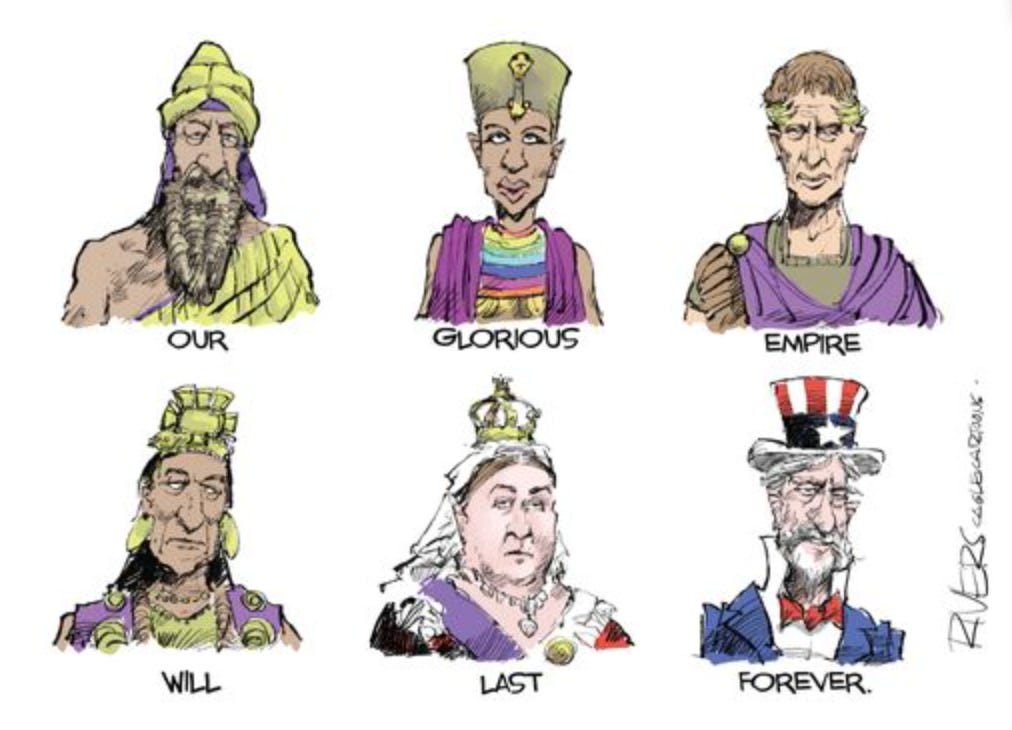
Source: Rivers, www.CartoonStock.com
America’s version of the horse problem
What was the American equivalent of Tang cavalry dominance? What was the strategic asset that made rivals cautious and allies loyal?
Trust.
Not naive trust — but the hard-earned, repeatedly-tested belief that the United States was a different kind of great power. That it would consider other countries’ interests alongside its own. That its commitments meant something. That it operated, however imperfectly, within a rules-based framework it helped create and genuinely respected. That beneath the hard power was something hopeful: the decency, however flawed, of the American democratic experiment.
That is what led the historically bickering European states to put their armies under American command. It is what led China to buy hundreds of billions of dollars in US government debt, send its best students to American universities, and list its most ambitious companies on American exchanges. It is what inspired billions of people around the world to invest, emotionally and economically, in America’s conception of itself — as portrayed in its films, its universities, its founding documents, its imperfect but genuine democratic practice.
Chaffetz writes of the horse that it was a strategic asset “as consequential in its day as petroleum was to the twentieth century.” American soft power was the 21st-century equivalent: the resource that multiplied every other form of American strength, that made rivals hesitate and allies commit. You couldn’t conquer it or inherit it. You had to earn it, continuously, through your conduct.
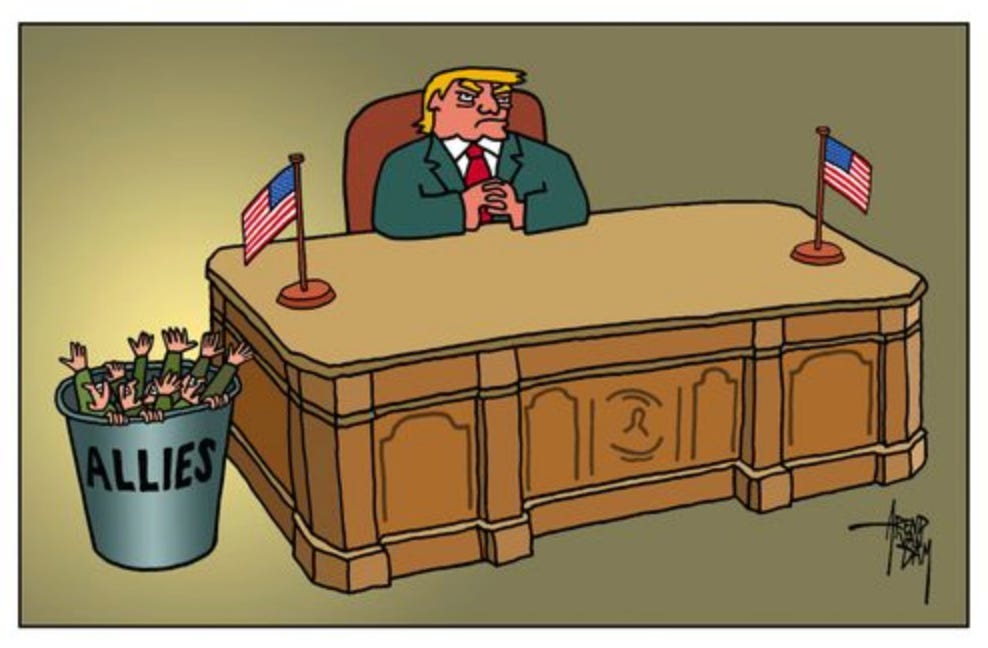
Source: Arend Van Dam, www.CartoonStock.com
Former allies are not waiting to find out if America will return to form. They are already building alternative supply chains, alternative security architectures, alternative ideological frameworks. They are doing, in other words, exactly what the steppe powers did after Tongguan: filling the vacuum, extracting advantage, and adopting an increasingly adversarial posture toward American interests.
The United States has not been conquered. But it has, like the post-755 Tang, abdicated the strategic position that made it preponderant. What follows a loss like that is not sudden collapse — it is grinding, increasingly unstable decline. And in 21st-century circumstances, it will not take centuries to unfold.
What should we do with this?
We shouldn’t despair at the Tang comparison. Much has been lost, but much remains to be saved. And history doesn’t simply repeat. What history can do is to give us a vantage point above the immediate crisis: A vantage point that reveals the shape of what is happening.
Two steps suggest themselves.
Lift our gazes. We should not think of the closing of the Strait of Hormuz as primarily a story about the price of gas, however directly it affects our wallets or commutes. It is a bigger story — about a turning point, one of those rare moments when the underlying structure of the world shifts, when what seemed permanent turns out to have been contingent all along. By the time Tang subjects fled Chang’an in 756, their only concern was survival. We have the luxury, right now, of a little distance. Let’s use it. The question worth asking is not when will the price of oil come down but what kind of world is being built in the wreckage of the one we knew?
Resist the pull of our own certainties. The historical parallels drawn here — Tang decline, American overreach, the cost of abandoning a strong defensive position for a reckless offensive — represent one interpretation of this moment. Not the only one. Others read the same events differently: as a necessary rupture with a liberal international order that had itself become a form of imperial management; as a correction of strategic overextension; as the birth pangs of a new and more honest multipolar world. I don’t find those interpretations persuasive. But the fact that serious people hold them is not a weakness — it’s a resource. No single lens on an event reveals all the perspectives worth drawing from it. By discussing our different takes, respectfully, we can construct a fuller, more resilient response to the challenges we face.
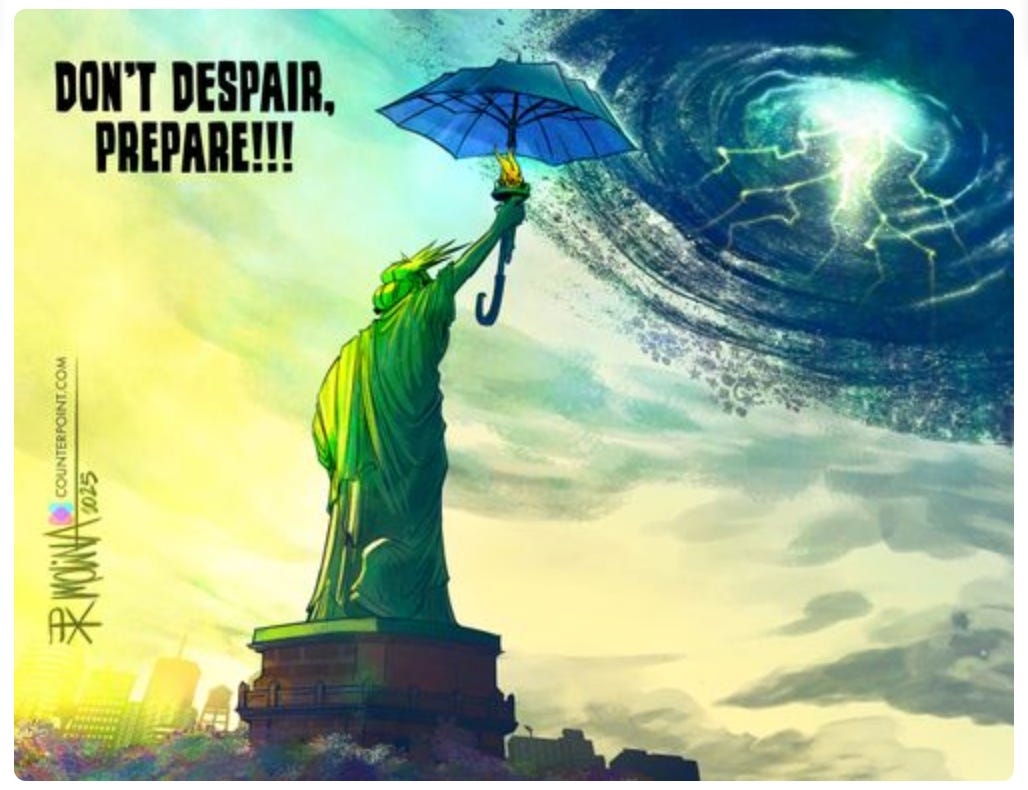
Source: Pedro Molina, www.CartoonStock.com
Chaffetz makes a powerful point in Raiders, Rulers, and Traders: access to horses was the decisive strategic factor for 2,000 years — and then this was “largely forgotten,” crowded out of our mental picture of history by more familiar factors. Our current political culture has a similar problem. The extreme polarization of the moment makes it nearly impossible to consider the world from any vantage point other than the one one’s tribe has already staked out. The right sees a corrupt globalist order finally being dismantled. The left sees American democracy being destroyed from within. Both are looking at events through lenses ground in the same decades, the same culture war.
History offers a third option: the long view, multiple perspectives, the ability to weave a stronger common response from many contrasting threads. We are in the midst of swings of fortune of global scale, reach, and complexity — to which too many of our fellow citizens are closing their eyes. We don’t have to sit out that game.
By learning, and discussing, the patterns of history, we can once again direct our course amidst the storms.
There is a tide in the affairs of men
Which, taken at the flood, leads on to fortune…
On such a full sea are we now afloat;
And we must take the current when it serves,
Or lose our ventures.4
We are afloat on that sea right now. Many currents are running. The question is whether we are paying enough attention to choose among them wisely.
The best single-volume history of the Tang Dynasty in English is China’s Cosmopolitan Empire: The Tang Dynasty, by Mark Edward Lewis. Harvard University Press, 2009.
Raiders, Rulers, and Traders: The Horse and the Rise of Empires, by David Chaffetz. W. W. Norton & Company, 2024. It was Economist Best Book of the Year and a New York Times Book Review Editors’ Choice.
The strategic aspects of the Tang empire are sketched out in The Pursuit of Dominance: 2000 Years of Superpower Grand Strategy, by Christopher Fettweis. Oxford University Press, 2023.
Julius Caesar, by William Shakespeare.
Another deeply thoughtful and revealing post. That's two great ones in a row.
Brilliant as usual, Javier. You continually manage to reshape my perspective on socio-cultural, political matters. Most recently I struggle with my ineffectual efforts to make a difference. Your essay lands beautifully and serves to soften my personal lament about one person's effectiveness against a daily onslaught of life-altering machinations by our current government.